



WE PUBLISH TAX STRATEGIES FOR…
FEATURED CONTENT
ERC Rebellion: A CPA’s Toolkit for Dealing with Disregarded Advice
Question: I have several long-term clients I’ve advised they didn’t qualify for ERC under the requirements. I’ve discovered over time that all three were sold by an ERC mill and filed amended tax returns to claim credits. What are the risks they will be audited and what are my responsibilities in representing them? Should I release them as clients because they didn’t listen to me? Answer: You know, the Employee Retention Credit (ERC) might sound like a pretty sweet deal, especially if your business took a hit during the pandemic. It's a tax break designed to help you out. But don’t be fooled. It's not as simple as it sounds. You need to know the ins and outs before you jump in. Some new kids on the block, a bunch of specialist firms, are offering to help businesses claim this ERC. Unless you’ve been trapped in a cave (or under a pile of tax files) you’ve probably seen the mail, heard the commercials, clicked the ads. They make it seem so easy, don’t they? Just let us take care of everything and ignore the rules. This is music to the ears of employers – especially if we’ve already told them based on the rules, they don’t qualify. We want our clients to know they gotta be careful. These mills may promise you the moon and the stars, but the reality is, there's a pretty tight rule book on how and when you can claim the ERC. Misunderstanding these rules could mean you lose out on a potential $26,000 tax credit per employee. Worse, you could be tricked into claiming money you're not actually entitled to and end up with a nasty surprise later. And when you factor in the steep fees charged by these fly-by-nights, often up to 30% of promised refunds - there is a real risk of loss should these businesses lose their claims.
Read MoreCURRENT EDITION

Tax Research in an AI World
It has never been harder to do quality tax research than at any time in my 43-year career in tax accounting. In the 1980s, when I was part-time in the industry, there was no internet. Since I was part-time, I ordered Publications 1132, 17, and 334. The rest I found at the library. A few hearty souls might even remember when the post office had stacks of tax forms for the public. Once I went full-time for the 1989 tax season I needed more resources. CCH was my tool of choice. I still used IRS publications and the library. My handy reference guide of choice was, and still is, the QuickFinder. I never used TaxBook much, but it is another good resource for general answers. Then came the internet. The promise was that we would have the world at our fingertips. And for the large part we did, only we forgot some things we would rather keep at an arm’s length. The internet slowly allowed us to replace rooms in our office filled with tax guides and forms with online resources. Law offices and accounting firms often wrote tax articles on narrow tax subjects. Research was easier than ever.
Then came AI.

Trump Accounts Are Live. Are They Spectacular?
Trump Accounts (or § 530A accounts) went live via app on July 4, 2026. According to the Treasury Department, over six million accounts have been opened. As of Monday, July 6, 2026, parents and guardians of account beneficiaries could use the app to view their children’s accounts, fund the accounts, and access balances and financial education information. The Treasury Department designated BNY Mellon “as a financial agent of the U.S. government to support implementation of the new Trump Accounts program.” BNY, in partnership with Treasury, will manage the accounts and help to develop the app taxpayers can use to manage their accounts. Robinhood Securities, LLC is acting as the initial trustee and brokerage for the accounts.
Explore Our Free Articles
Get a taste of our comprehensive tax planning insights with four featured articles, free for everyone.

What Happens If You Can’t Use All Your Clean Energy Tax Credits This Year?
Clean energy tax credits have a lot going for them. Clients buy them at a discount, apply them dollar-for-dollar against federal tax liability, and walk away paying less to the IRS. That alone makes them worth a serious look. But here’s what often gets overlooked and what makes these investments

Contracts, Signing Bonuses, and the Substantial Presence Test
In tighter job markets, recruits are often offered signing bonuses (and sometimes moving expenses) to join a firm. Sometimes construction workers temporarily relocate to jobs in other states while they are employed by the company that hired them in their home state. This article reviews some of the foundational tax

Start the Year Right: Your WISP Doesn’t Have to Be a Tax Season Nightmare
The mere mention of a WISP makes most tax professionals want to suddenly lose their internet connection. It sounds bureaucratic, technical, and deeply unfun. But here’s the good news: creating and maintaining a WISP does not have to feel like a compliance root canal. And ignoring it can turn into

The Corporate Vault: How to Use a C Corporation to Stockpile Cash for the Future
When most people think about saving for the future, their minds jump to retirement accounts—401(k)s, IRAs, maybe even defined benefit plans. But business owners have another option that often goes overlooked: using a C corporation as a strategic savings vehicle. By leveraging the flat 21% corporate tax rate, smart income
Exclusive Webinars for Our Subscribers
As an annual subscriber, you gain complimentary access to our series of expert-led webinars. Each session is designed to provide you with insights, skills, and knowledge to excel in your field. Discover what’s coming up and secure your spot today.
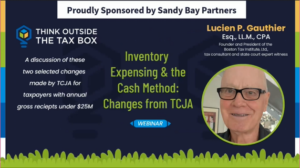
Inventory Expensing and The Cash Method: Changes from the TCJA
Join Lucien P. Gauthier as we discuss these two changes made by the TCJA in depth.
Taking the Mystery Out of Revised Energy Credits for Individuals
Learn valuable tips to help your clients claim the new residential energy and electric vehicle credits.
Tax Season 911
Your preparedness plan to create tax savings and survive the busiest of times without falling into old habits!
Don't Miss Our Next Webinar
Mark your calendar and stay ahead of the latest tax planning strategies and regulations
Webinar
TBD
Featured Authors
Amber Gray-Fenner is an Enrolled Agent and tax practitioner specializing in tax returns, planning, and representation for individuals and small businesses. She owns Tax Therapy, LLC in Albuquerque, New Mexico.
Matt Metras, EA, owns MDM Financial Services in NY, specializing in bookkeeping and taxation for cryptocurrency clients. He’s an educator on cryptocurrency taxation and actively engages in community advocacy.
Jeff Stimpson, has been a tax and finance writer for 25 years. Hee contributes to publications like Accounting Today and Financial Advisor. His other credits include sales tax, technology, and practice management, residing in New York.
Annette Nellen is a professor and tax program director at San José State University, with extensive involvement in tax organizations and a focus on tax policy, cryptocurrency, and education.
Peter J Reilly graduated from the College of the Holy Cross, worked in CPA firms like Joseph B Cohan and Associates and CCR LLP, and now runs a tax practice while writing for Forbes.com.
Thomas Gorczynski, EA USTCP CTP, is a tax expert known for speaking and educating on federal tax law. He’s editor-in-chief of EA Journal, co-author of the PassKey Learning Systems EA Review Series, and runs a tax practice in Phoenix, Arizona.
Hear From Our Satisfied Users
Quotes from users who have benefited from Tax Law Pro, highlighting how it has helped them in their tax planning and compliance efforts.
SIMPLIFIED TAX STRATEGIES &
PRACTICAL IMPLEMENTATION
Think Outside the Tax Box provides tax reduction strategies along with practical
implementation advice in order to reduce your clients’ federal tax bill with ease.