


Buried in the middle of the One Big Beautiful Bill Act (OBBBA) is a small section with huge tax savings for multifamily developers – expansion of the 460(e) revenue recognition method exceptions. Previously only available to smaller construction contractors, the new law opens up a potential windfall for larger scale developers.
OBBBA delivered plenty of headline-grabbing tax changes, but one of its most valuable provisions is seriously under-discussed. While not as hot of a topic as 100% bonus depreciation, expanding access to use significant revenue recognition deferral methods is a gold mine for savvy developers.
Construction Taxation Generally
There are two primary types of tax income recognition methods used in construction – Percentage of Completion Method (PCM) and Completed Contract Method (CCM). To get a good foundation of how the OBBBA changed the landscape for contractors, we need to understand how these two methods work.
PCM is the most “accrual” of the two methods. Under this method, the contractor records revenue as costs are incurred, regardless of when the owner (or customer) is billed. It requires a contract amount and “estimated cost to complete” amount. This method recognizes profit over the life of the contract.
CCM, on the other hand, does not recognize income until the contract is “substantially complete.” Unsurprisingly, there is no bright-line test for measuring “substantially complete,” but in practice it’s understood as being ready for intended use and roughly 95% of all costs incurred. Until this stage is reached, the costs are capitalized as “Work in Process” (WIP), and the billings are recorded as “Deferred Revenue” or the like. Once the project is complete, the liability is recognized as income and the WIP recognized as costs of goods sold.
Let’s compare taxable income results with an example:
Contract Date: July 1, 2026
Contract Amount: $10,000,000
Estimated Cost to Complete: $8,000,000
Actual Costs Incurred at December 31, 2026: $4,000,000
Actual Billings to Owner at December 31, 2026: $6,000,000
Below is the calculation (WIP Schedule for those in the know) of revenue to be recognized under PCM:
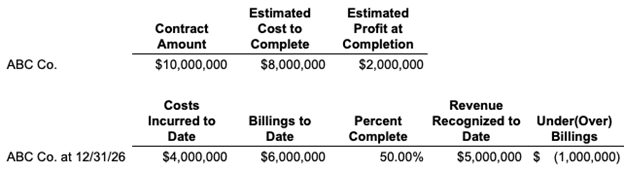
Under PCM, this contractor would recognize $5,000,000 of revenue and $4,000,000 in contract costs (expenses) during this tax year – or $1,000,000 of taxable profit. This makes sense, as the contract is halfway complete based on cost estimates ($4,000,000 costs incurred out of an expected $8,000,000).
Alternatively, under CCM, this contractor would record $0 revenue for this contract and $0 in contract costs as the project is only halfway complete and far from being ready for intended use by the owner.
Most contractors won’t tell you they’ve made profit on a contract until their last (or next to last) billing. So CCM works to accelerate the income tax burden of a job that starts out well but ends poorly.
Construction Taxation Before OBBBA
Congress understood this burden, and in an effort to incentivize homebuilding introduced IRC 460(e). Prior to OBBB, 460(e) read, in part:
(e) Exception for certain construction contracts
(1) In General
Subsections (a), (b), and (c)(1) and (2) shall not apply to—
(A) any home construction contract, or
(B) any other construction contract entered into by a taxpayer (other than a tax shelter prohibited from using the cash receipts and disbursements method of accounting under section 448(a)(3))—
(i) who estimates (at the time such contract is entered into) that such contract will be completed within the 2-year period beginning on the contract commencement date of such contract, and
(ii) who meets the gross receipts test of section 448(c) for the taxable year in which such contract is entered into. [1]
In plain English, the requirement to use PCM as a revenue recognition method is waived for contractors that either: (1) enter into “home construction contracts”, or (2) are under the §448(c) gross receipts test and who estimate the contracts will be complete within 2 years.
Home construction contracts are generally defined as contracts to construct “dwelling units contained in buildings containing 4 or fewer dwelling units…” [2] That would include single family homes, duplexes, etc.
The §448(c) gross receipts test is commonly referred to as the “small business” threshold – currently at $31,000,000. This amount is compared to the average gross receipts of the business for the last three years.
In practice, before OBBBA, contractors could use the CCM method only if they were building properties with four or fewer dwelling units OR were under the gross receipts test.
This meant that large multifamily developers were forced into using PCM (disregarding the alternative 70% method that is outside the scope of this article) and accelerating income tax burden.
Construction Taxation After OBBBA
If, like me, you spent the wee hours of the weekend after July 4, 2025 reading the OBBBA text, you may have skimmed right over this section. It is only 165 words long and dropped exactly halfway in OBBB at page 434 of 869.
Effective for contracts entered into in taxable years beginning after the date of the OBBBA (new contracts entered into January 1, 2026 and beyond for most contractors), these changes level the playing field for large multifamily developers.
Here is the full text of this section:
(a) In General.–Section 460(e) is amended–
(1) in paragraph (1)–
(A) by striking “home construction contract” both places it appears and inserting “residential construction contract”, and
(B) by inserting “(determined by substituting ‘3-year’ for ‘2-year’ in subparagraph (B)(i) for any residential construction contract which is not a home construction contract)” after “the requirements of clauses (i) and (ii) of subparagraph (B)”,
(2) by striking paragraph (4) and redesignating paragraph (5) as paragraph (4), and
(3) in subparagraph (A) of paragraph (4), as so redesignated, by striking “paragraph (4)” and inserting “paragraph (3)”.
(b) Application of Exception for Purposes of Alternative Minimum Tax.–Section 56(a)(3) is amended by striking “any home construction contract (as defined in section 460(e)(6))” and inserting “any residential construction contract (as defined in section 460(e)(4))”.
(c) Effective Date.–The amendments made by this section shall apply to contracts entered into in taxable years beginning after the date of the enactment of this Act. [3]
So what did this do in plain English? I’ve written the new 460(e) section out with these amendments, but won’t include them here lest the readers’ eyes glaze over further.
Here’s the summary:
- Change “home construction contract” in §460(e)(1)(A) to “residential construction contract” – opening up this exemption to multi-family builders with gross receipts in excess of the 448(c) threshold.
- Excludes residential construction contracts from section 263A who estimate the project to be completed within a 3-year period AND meet the 448(c) gross receipts threshold.
A contractor no longer needs to develop four or fewer dwelling units per building to qualify for the exception to using PCM. So long as they are a qualifying residential construction contractor, contracts entered into after this year are eligible for significant deferral under CCM.
What’s Next
This is big.
If you have a large multifamily developer as a client, this should be in your mid-year and end-of-year meeting agenda to discuss. It should also be brought to their attention broadly sooner rather than later in the event they want to delay “entering into” new contracts that would be available under CCM beginning next year.
Should they want to qualify eligible contracts as CCM, their accounting team would also want to be made aware of the contract information you would need for income tax reporting.
Finally, state guidance should be followed closely. This may result in large federal to state differences for non-conforming states.
We likely receive additional guidance on this smallest of provisions, so wait for that as well. But this is a potential windfall for growing developers who are entering into new contracts in the next six months.